
History & Mission
WESTPHAL TODAY
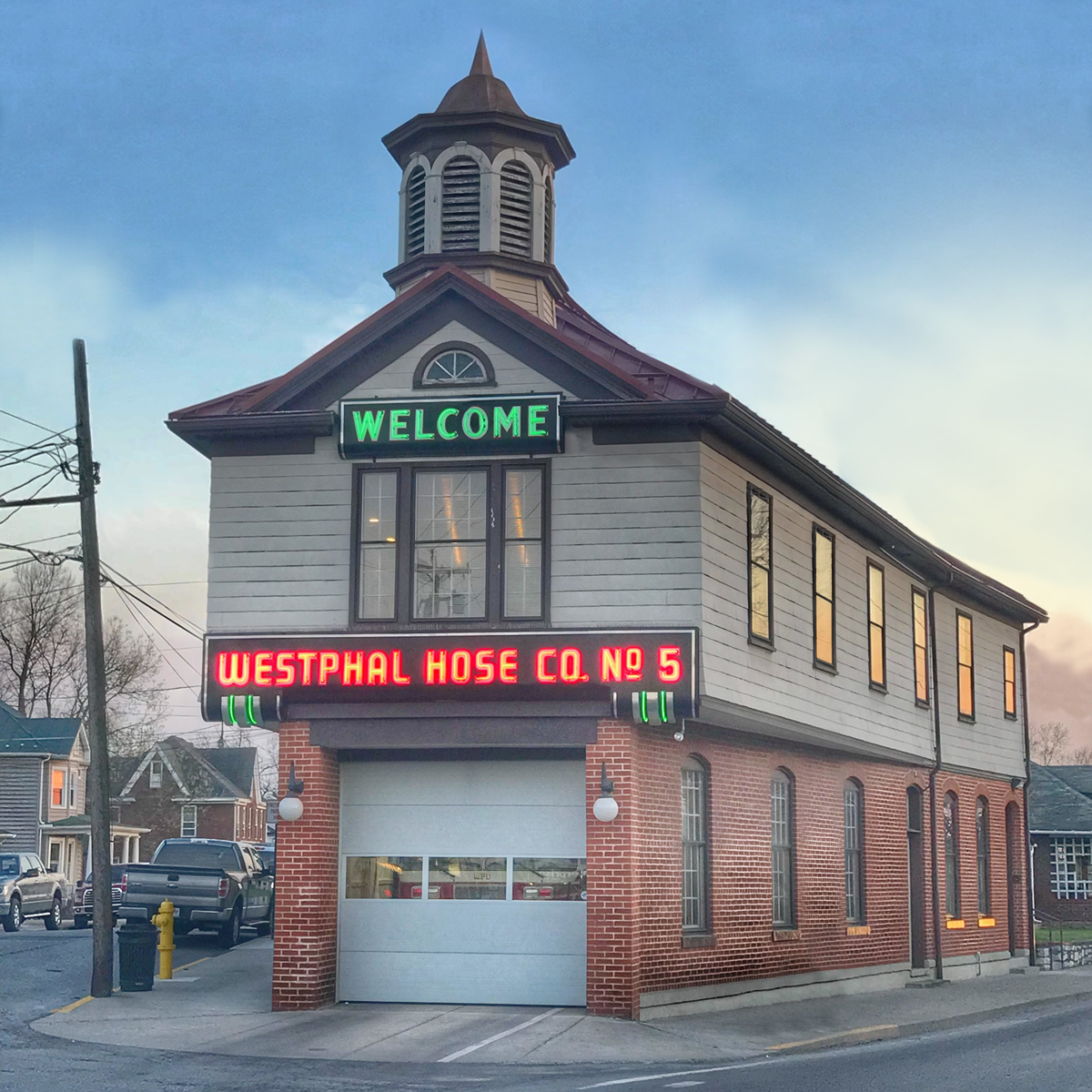
Westphal Hose Company No. 5 is an active volunteer fire department that was organized February 26, 1906 and has been located at 715 N. Queen St in Martinsburg, West Virginia since 1913. Westphal is a supporting arm of the Martinsburg Fire Department and shares occupancy of the building with paid firefighters and houses one fire engine.
MISSION STATEMENT
The mission of Westphal Hose Company No. 5, an extension of the Martinsburg Fire Department, is to assist in protecting life and property from fire or any other destructive forces.

W.W. WESTPHAL
William W. Westphal died at his house, located at 200 W. Race Street, on Friday July 18, 1941. Westphal Hose Company No. 5, which bore his name, oversaw funeral arrangements. Mr. Westphal was a veteran banker, farm owner, and volunteer fireman’s organization executive.
Mr. Westphal had served as director of the Old National Bank and as president of Hose Company No. 5 for 27 years. The fire company was named after Mr. Westphal in 1937. He named the fire company as one of the main beneficiaries in his will.


THE HISTORY OF MARTINSBURG FIRE SERVICE, & WESTPHAL HOSE COMPANY NO. 5
Originally written by Don Wood, Revised by Travis Shroades
Located at the intersection of North Queen and Second Street is the brick building which has served as the home of Hose Company No. 5 since 1913. Before purchased by the Hose Company, one of the wooden Granger Hall buildings stood on the lot.
The present architecturally and historically significant building gives an excellent welcome to people entering the seven, soon to be nine, historic districts of Martinsburg. The notable building was listed in December 1980 in the National Register of Historic Places as one of the outstanding buildings of the East Martinsburg Historic District, which begins at the intersection of North Queen Street and Moler Avenue.

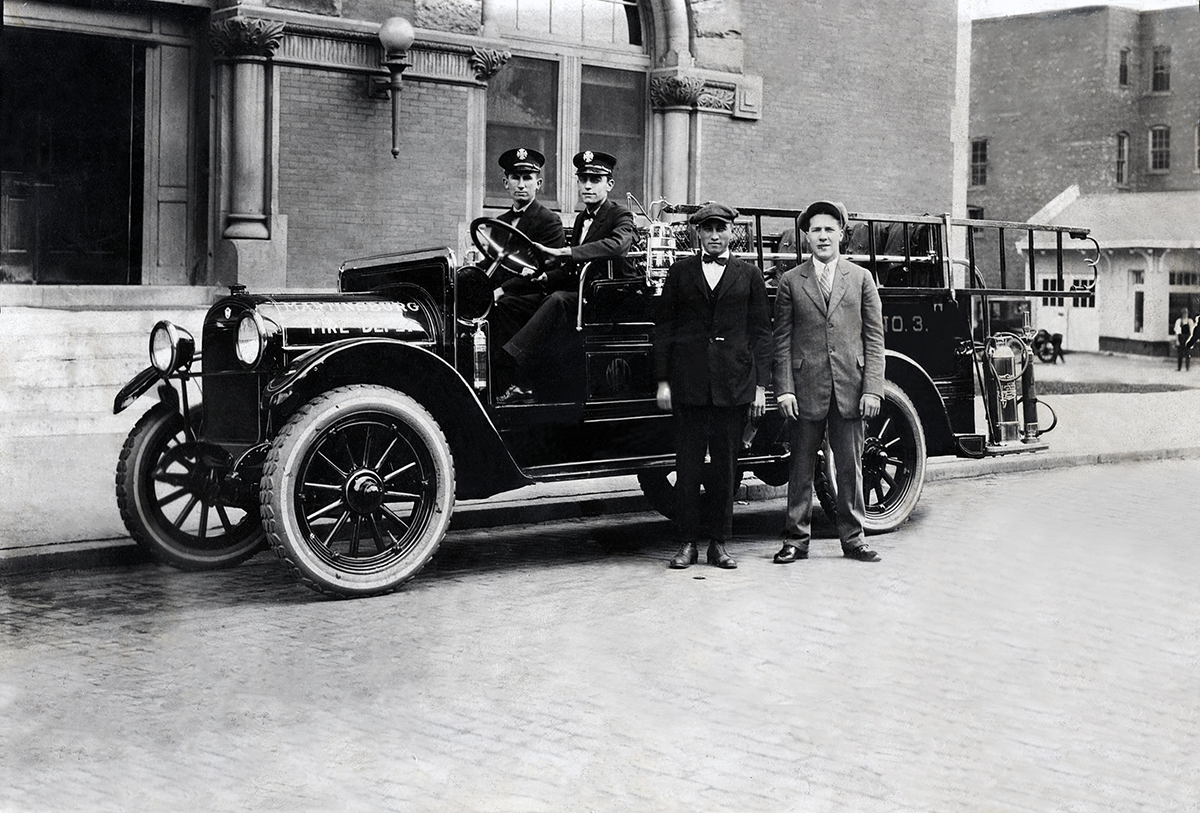

The history of the fire service in Martinsburg, WV, can be traced to 1823. On the 7th of February 1823, the town trustees formed a committee to buy four long ladders, two short ladders, and 20 buckets to be used for the towns. The committee consisted of Jacob Bishop and Edward Gibbs. The new fire equipment was stored in the Market House.
On the 8th of November 1825, there was a fire in town that destroyed two houses. On the 9th of November 1825, the town trustees were called to the scene to discuss the topic of purchasing a hand fire engine. A committee was again formed to secure the engine for the town. The committee consisted of Conrad Hogermine, John Strothers, and Jacob S. Lauck. The town trustees authorized the town’s treasurer to pay $500 for the engine.
There is no further information until the 13th of June 1829, when records state a hand engine was purchased from Merrick & Agnew of Philadelphia, PA, for $500. They brought the engine in by rail to Baltimore, MD, from Philadelphia. It was then hauled over “the pike” to Martinsburg.
On the 26th of October 1831, it was decided the town needed a water supply for fire suppression. The trustees ordered the construction of a cistern in front of the courthouse for use in fires.
August 29th 1846, the trustees of the town decided a new market house and engine house were necessary.
On the 12th of May 1859, John Biondel was instructed to examine a fire engine from Baltimore Hose Company #1 to possibly purchase this engine. Seven days later records show the engine was purchased for $762.50.
John Q.A. Nadenbousch and others petitioned the town council on the 9th of June 1857 for permission to use the engine and apparatus to form a fire company. Mechanical Fire Company was the name for the new organization. The amount of $30 annually was appropriated by the council for the salary of the fire superintendant.
A steam fire engine and two reels with hose were purchased by the town council on the 22nd of July 1867. The price of $8,175.00 was paid to the Silby Engine Company of Seneca Falls, NY. H.M. Couchman made the motion to the council for the purchase. This engine would be the first steam engine owned by the city of Martinsburg.
The council approved $500 towards the purchase of a ladder truck on March 9, 1868. This was the start of the hook and ladder company. On December 12, 1870, the “Martinsburg Fire Company” was formed. The first fire marshal was Col. John Q.A. Nadenbousch.
On January 5, 1899 the following report, dated December 31, 1898, was presented by Chief Marshal of the Fire Department to Mayor John T. Pauling and council members present. These council members were C.C. Lemen, A.G. Wolfes, Geo. D. Roberts, W.R. Kline, John J. Foley, and W.M. McQuilkin of Martinsburg. This was the semi-annual report. The Fire Company had participated in the following parades: July 4, Nov. 24 and Dec. 28 and three fires, July 15- Harpers Ferry, Aug. 15- box car on B&O siding, and Dec. 28- Steam Laundry, King and Swartz Streets. Engine One was in fair condition with average steam and water pressure. 85 lbs. hose and reels were in good condition.
Number of members in the Fire Company were 77 officers, 11 Reel No. 1-14, No. 2-13, No. 3-10, No. 4-10, Hook and Ladder 13 and Police 7. The report thanks the council for new gum coats for the nozzleman. They suggest the council order four new nozzles, one for each reel.
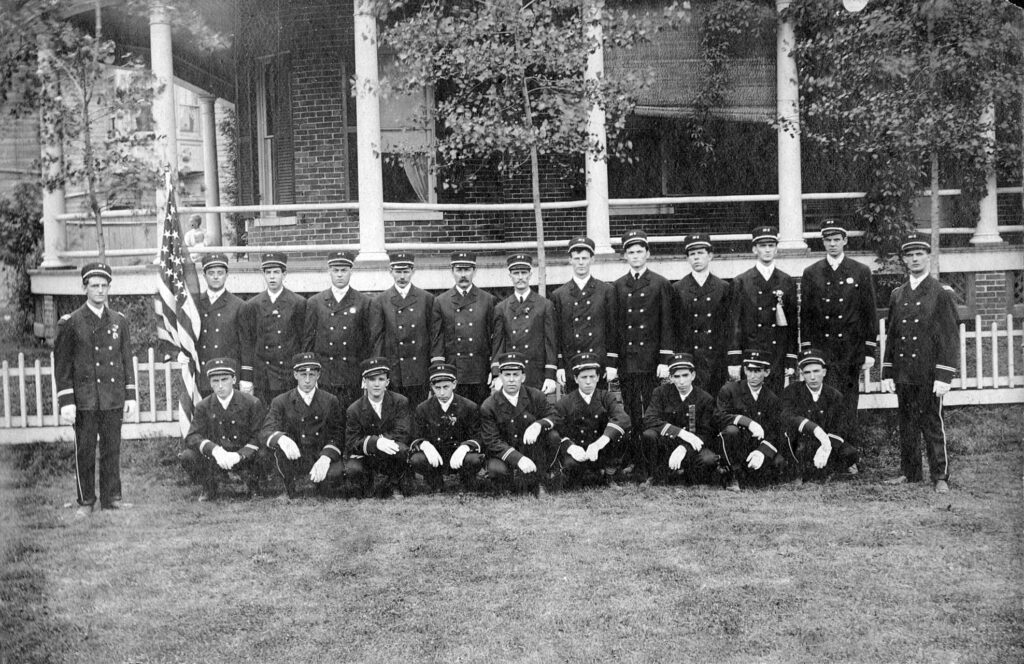
Over the next six years, citizens of Martinsburg were very unhappy with the lack of proper fire protection. Martinsburg had been growing. During the reconstruction days following the Civil War, Martinsburg had been divided into Wards with a free school set up in each ward.
On October 24, 1905, a report from a joint committee composed of members from the city council, businessmen’s association, and the fireman’s association on the needs of the fire department was given to the city council. X. Poole was the chairman and C.J. Thomas, secretary.
The committee recommended that if the citizens would furnish and equip the department with four suitable horses, a hook and ladder truck, and a combination hose wagon and chemical engine that the corporation of Martinsburg agreed to furnish a suitable building and maintain said horses and equipment. They would also employ as many paid firemen as would be necessary.
Secondly, that owing to the present condition of the fire department, that the fire company should be reorganized and that the City should take immediate steps for maintaining proper equipment for the protection of the city.
At a meeting of the joint committee appointed by the City Council, the board of trade, and the fire department, it was resolved that the city would make necessary repairs to a portion of the Market House building for proper temporary protection and housing of the city’s present fire equipment. It was also resolved that the fire company would be reorganized. After a couple of meetings, on Feb. 1, 1906, an ordinance establishing and reorganizing the Fire Department of the Corporation of Martinsburg was adopted, which placed the Department under the Fire Commission.


It was established that there would be five fire companies in Martinsburg and they were designated as follows: Ryneal Chemical No. 1 Hook and Ladder, No. 1 Steamer No. 1, these being combined into one company but divided into squads, Hose Co. No. 2, Hose Co. No. 3, Hose Co. No. 4 and Hose Co. No. 5. Each was to be located in each Ward of the City. Each Company should consist of twenty to sixty members. Firefighters would be required to attach themselves to the Company located in the Ward in which they resided unless the Fire Commission empowered otherwise. Each company was to have a Captain, Assistant Captain, Secretary, and Treasurer..
At the February 17, 1906 meeting of the city council, the joint committee of the members of the council, citizens, and firemen formally transferred the mayor and council of Martinsburg the equipment consisting of the Ryneal Chemical Wagon, horses, hanes, etc. to be placed under the jurisdiction of and in custody of the fire commission.
The mayor gave an accepting speech in which he recognized the gift from George Ryneal of $1,000, which had gone towards the purchase of the combination chemical hose wagon known as Ryneal No. 1. Funds had also been raised for purchase of other new equipment.
The Martinsburg Statesman carried the following statement: “The Fire Department, the Hose Company No. 1 met at the Fireman Hall on Tuesday night. There was a good attendance especially of associate members.”
Mr. Joseph Lyeth, Chairman of the organization, committee President, and J.F. Slaugher was temporary secretary.
Mr. George Ryneal, who was transferred from No. 2, was made president. Joseph Matthews was made captain. Chas A. Wolfes was made secretary. Jos Barrick was made treasurer. W.F. Slaughter was made assistant captain. J. Frank Thompson, T.E. Matthews, and J.H. Lyeth were delegates at the convention to elect a chief. X. Poole, J.T. Paulding, and T.E. Mathews were on the committee on by-laws.
The fourth ward held its meeting at the close of the meeting of the first.
The following officers were elected: Alonzo Stewart-president, S.R. Kline-secretary, Samuel Boehm-treasurer, Marvin Brenner-captain, J.D.Davis, J. Ryneal, and T.P. Kline-delegates, M.S. Brenner, Joseph Copenhavor, and Samuel Boemn-committee on by-laws.
The fifth ward organized at their own hose house on Monday night. They had a list of 54 active and 6 associate members. The election of officers resulted as follows: J.H. Lloyd-president, Fred Baker-secretary, Oscar M. See-treasurer, J.A. Brown-captain, Hunter Timberlake-marshal, W.J. Mills and J.T. Wolford-delegates to elect chief. A.H. Stanley, J.T. Wolford, and Hunter Timberlake were elected to the committee on construction and by-laws.
In April 1906, the new fire commission made a report to the city council for the urgent need of new water mains on John Street, and in certain other parts of the city. It was stated that there were frequent breaks in the old cement pipes which caused a lack of fire protection. This had been emphasized at the recent Woolen Mill Fire.
It was noted that Hose Company No. 5 already had a hose house where they met when their new company was formed. This was located on Hooge Street.
In August 1912, W.M. Welshance, president of Hose Company No. 5, appeared before the city council requesting assistance to build a new modern fire house as a home for the company.
They stated that they had purchased for the fifth ward hose company a lot at the intersection of North Queen and Second Street for erecting thereon a suitable and modern fire house. They had plans and specifications prepared for what we believe would be a building that not only would be a credit and an ornament to that section of the city, but would also meet the requirements of the company.
It was stated that the residents of that section of town had contributed very liberally when funds had been solicited. They did not have enough money to equip a building. They stated that they had poor equipment but had the largest most efficient and faithful company of volunteer service in the city.
In October 1912, a contract was presented to the council by Mr. Kerfoot for the erection of a hose house for the fifth ward hose company by contractor Geo. Keyton. On motion, it was ordered that the mayor be empowered to sign said contract.
In 1918, Hose Company No. 5 was to have further work. They purchased an additional 15 feet of land for said company for $225. The company had $1,500 in their treasury, which they turned over to the city to help defray the expense of the purchase for the additional ground and new fire engine. In June 1914, it had been ordered that the fire committee proceed at once to remodel the hose house of the fifth ward to permit the housing for the new fire truck which was ordered.